The short version
- Almost every large technology company now ships, or is about to ship, glasses with a camera in them. Meta alone held about 69% of the market in early 2026, and the category is expected to pass ten million units this year.
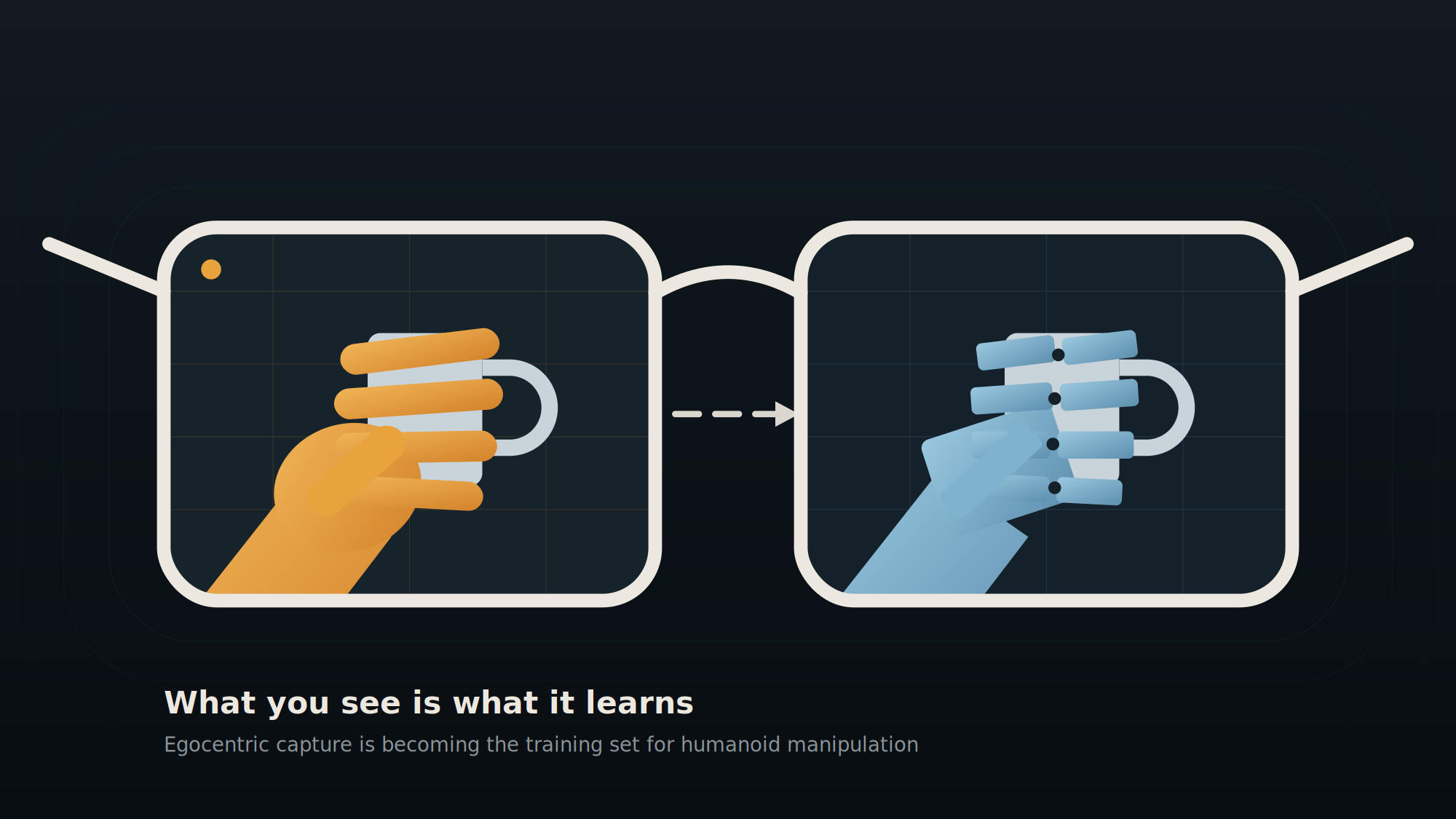
- What those glasses record is egocentric video — first person, hands in frame, head turning toward whatever matters next. That is the exact format humanoid robots learn manipulation from.
- A February 2026 paper found a log-linear scaling law: the more hours of human first-person video you train on, the better the resulting robot. The curve has the same shape that turned language models into an industry.
- Tesla already moved Optimus off motion-capture suits and onto workers wearing camera rigs. The camera-only argument it has defended for a decade in cars now applies to robots.
- China and India are both paying people by the hour to generate this footage by hand — state-funded training halls in one, head straps on garment workers in the other. Consumer glasses produce a lower-fidelity version of the same thing at close to zero marginal cost.
- The weak point is consent, not technology, and the bill for that has not come due yet.
- The prize is the pipeline rather than the eyewear, and whoever holds it owns the cost curve for physical labour.
In the space of about eighteen months, nearly every large technology company on earth decided that you should wear a camera on your face.
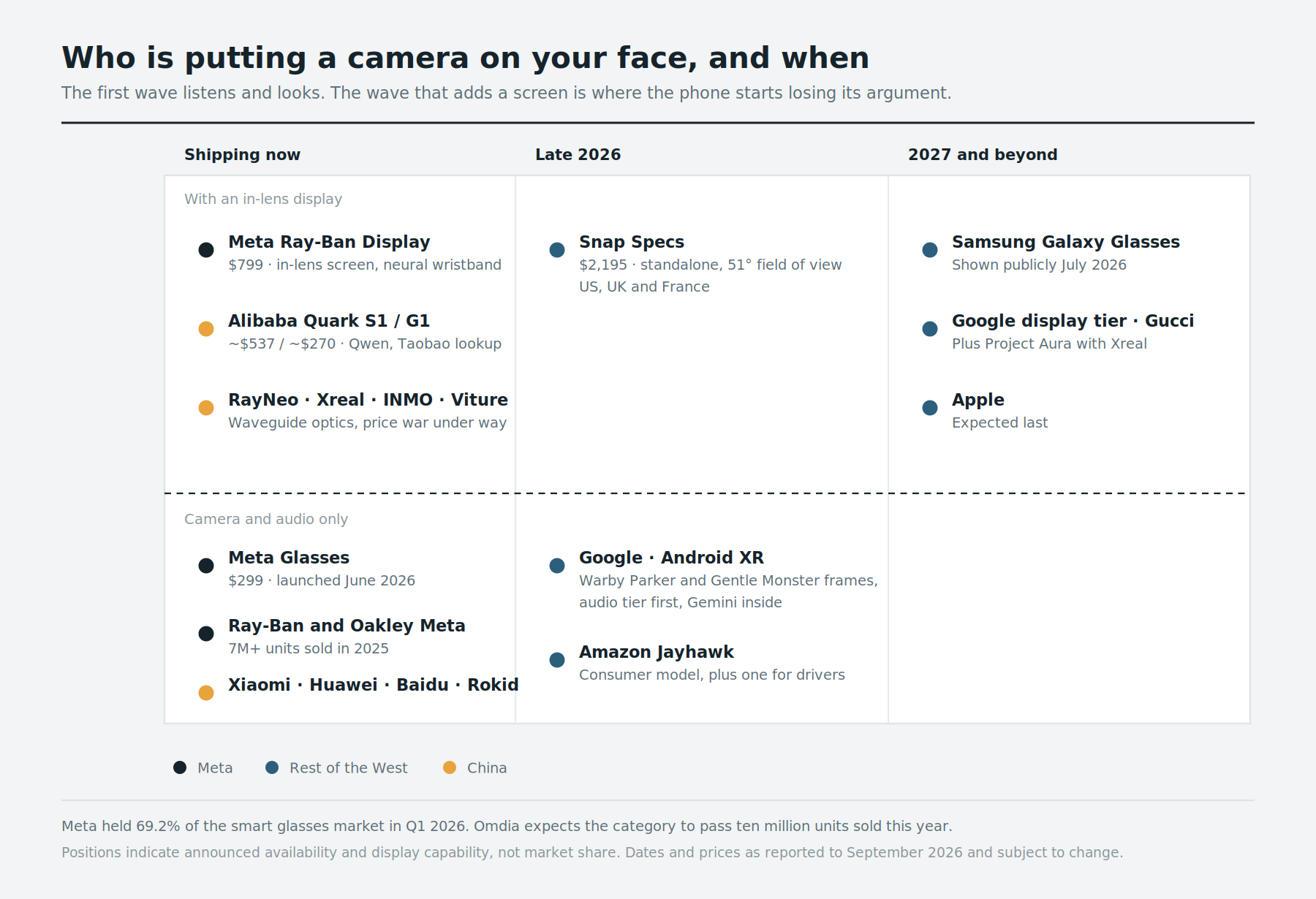
Meta is furthest along and it isn’t close. EssilorLuxottica reported over seven million Meta AI glasses sold in 2025, and IDC put Meta’s share of the smart glasses market at 69.2% in the first quarter of 2026. The lineup now spans the $299 Meta Glasses launched in June 2026, the Ray-Ban and Oakley lines, and the $799 Ray-Ban Display with an in-lens screen and a gesture-reading neural wristband.
Google is coming with Android XR and Gemini, built with Warby Parker and Gentle Monster, audio-first frames landing in late 2026 and display models behind them, with Gucci indicated for 2027 and Project Aura — the wired XR glasses built with Xreal — aimed at developers. Samsung showed its Android XR eyewear publicly in July 2026. Snap unveiled Specs at AWE in June: standalone, see-through, 51-degree field of view, $2,195, shipping this fall in the US, UK and France, with Evan Spiegel openly calling it a bet on a post-smartphone world. Amazon is developing two models, a consumer device and a version for its own delivery drivers. Apple is expected to arrive last, somewhere around 2027.
And then there is China, where the category is not a rumour but a price war. Alibaba shipped Quark AI Glasses in two tiers, roughly $270 and $537, with Qwen models, in-lens displays, and Taobao price lookup on whatever you happen to be looking at. Xiaomi, Huawei and Baidu are all in. So are Rokid, RayNeo (TCL), Xreal, INMO, Viture. Chinese regional trade-in subsidy programmes began covering smart glasses for the first time in 2026, and both Xreal and Rokid have moved toward Hong Kong listings. Omdia expects global smart glasses sales to pass ten million units in 2026.
When this many companies with this little in common converge on the same form factor in the same eighteen months, something other than fashion is driving it. It is a land grab, and it is worth asking what exactly is being grabbed.
The utility is real, and that matters more than the hype
Start with the unglamorous part, because the rest depends on it.
These things are genuinely useful now, in a way the 2013 Google Glass generation was not. Ask about what you are looking at and get an answer. Translate a menu or a street sign without breaking eye contact. Turn-by-turn navigation in your field of view instead of in your palm. Hands-free capture while you are cooking, fixing a bike, holding a child. Meeting notes that write themselves. None of this is speculative — it ships today, and the reason it works is that the AI layer finally caught up to the hardware. The 2016 versions had a camera and nothing useful to do with what it saw. That is the part that changed.
People will wear these because they get something out of them. Everything else in this piece depends on that.
What the footage actually is
What comes off a pair of glasses is egocentric video: first-person, head-mounted, hands entering and leaving the frame, objects occluding each other, the viewpoint swinging every time you turn to look at something. Nobody would shoot a film this way. It happens to be exactly what a humanoid robot needs in order to learn manipulation.
This is not a theory I am floating. It is the direction the entire robot-learning field has already turned. Meta’s Project Aria research glasses were built precisely to collect it, and Ego4D and Ego-Exo4D — thousands of hours of everyday first-person activity — exist for the same reason. A Georgia Tech project called EgoMimic trained humanoid manipulation from Aria footage of a person folding a t-shirt. In April 2026, a consortium spanning Georgia Tech, Stanford, UC San Diego, ETH Zurich, MIT and Meta Reality Labs released EgoVerse: over 1,300 hours of egocentric demonstration across nearly 2,000 tasks and 2,000 demonstrators.2
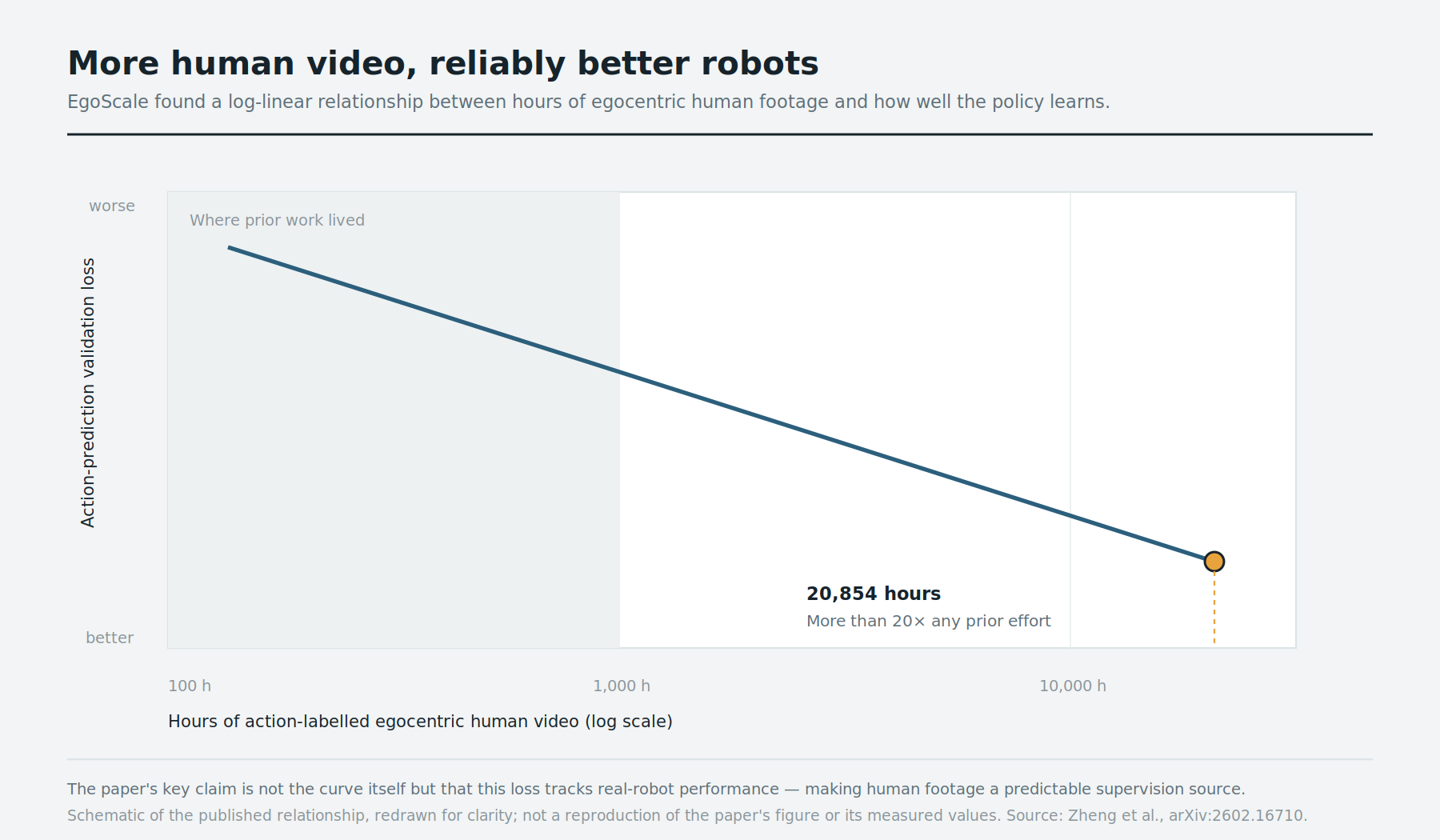
One result from February got considerably less attention than it deserved. EgoScale trained a vision-language-action model on more than 20,000 hours of action-labelled egocentric human video and demonstrated a log-linear scaling law between the volume of human data and validation loss — with that loss correlating to how well the resulting robot actually performs.1 In plain terms: more human first-person video reliably produces better robots. That is the same shape of curve that turned language models from a research curiosity into an industry.
The reason this matters is cost. The traditional way to teach a robot is teleoperation: a human drives the robot’s joints through a task, hundreds of times, recording as they go. It is slow, it is expensive, it needs a robot per demonstrator, and it caps out. Human video does not. There are eight billion demonstrators already walking around, and the ones wearing glasses are recording.
The Tesla argument
If you want to know whether cameras alone are enough, look at what happened in mid-2025, when Tesla moved the Optimus programme away from motion-capture suits and teleoperation toward a vision-first approach: workers wearing camera rigs, performing ordinary tasks — folding laundry, wiping a table, picking things up — and the footage going straight into training. Ashok Elluswamy, who ran Autopilot, took over the programme and brought the Autopilot philosophy with him.3
That philosophy is the same one Tesla has defended for a decade in cars, against an industry that insisted on LiDAR and radar. The argument was always simple: humans drive with two eyes and no rangefinder. We do not measure distance, we estimate it, and we estimate it well enough. If the biological system works on vision alone, a sufficiently good learned system should too — and it will cost a fraction as much to build, which means you can put it on far more units, which means far more data, which means it improves faster. Camera-only slashes the bill of materials, and the fleet advantage compounds.
Whether Tesla has won the autonomy race is genuinely contested — Waymo’s sensor-rich approach has its own strong case, and reasonable people disagree. But the cost-and-scale logic has been vindicated regardless of who ends up ahead, and it transfers cleanly to robotics. Tesla is now betting Optimus on it, and it is not alone: Figure’s Helix and 1X’s world model for NEO are variations on the same idea of learning tasks by watching humans.
Apply that to glasses and the picture gets interesting. The objection to consumer footage is that it lacks the sensor channels a robot supposedly needs — force feedback, joint angles, proprioception, precise depth. That objection is real, and I am not going to pretend otherwise: video alone will not teach a robot how hard to grip an egg. But it understates how much is recoverable from the video itself. Head motion is a signal — it tells you where attention went, when the person committed to an action, how they braced. Optical flow gives you structure and depth. Hand pose is extractable frame by frame. Timing, sequencing, approach angle, the order of subtasks, what gets looked at before it gets touched: all of it is in the pixels. Most of the sensor data you did not capture can be estimated closely enough for pretraining.
Glasses footage is not a replacement for teleoperation. It is the pretraining corpus that makes teleoperation cheap — the base layer, with fine motor precision fine-tuned on top. Which is exactly how every other modality in modern AI has worked.
Nobody is waiting for the glasses
If you want evidence that this data has real value, look at who is already paying for it.
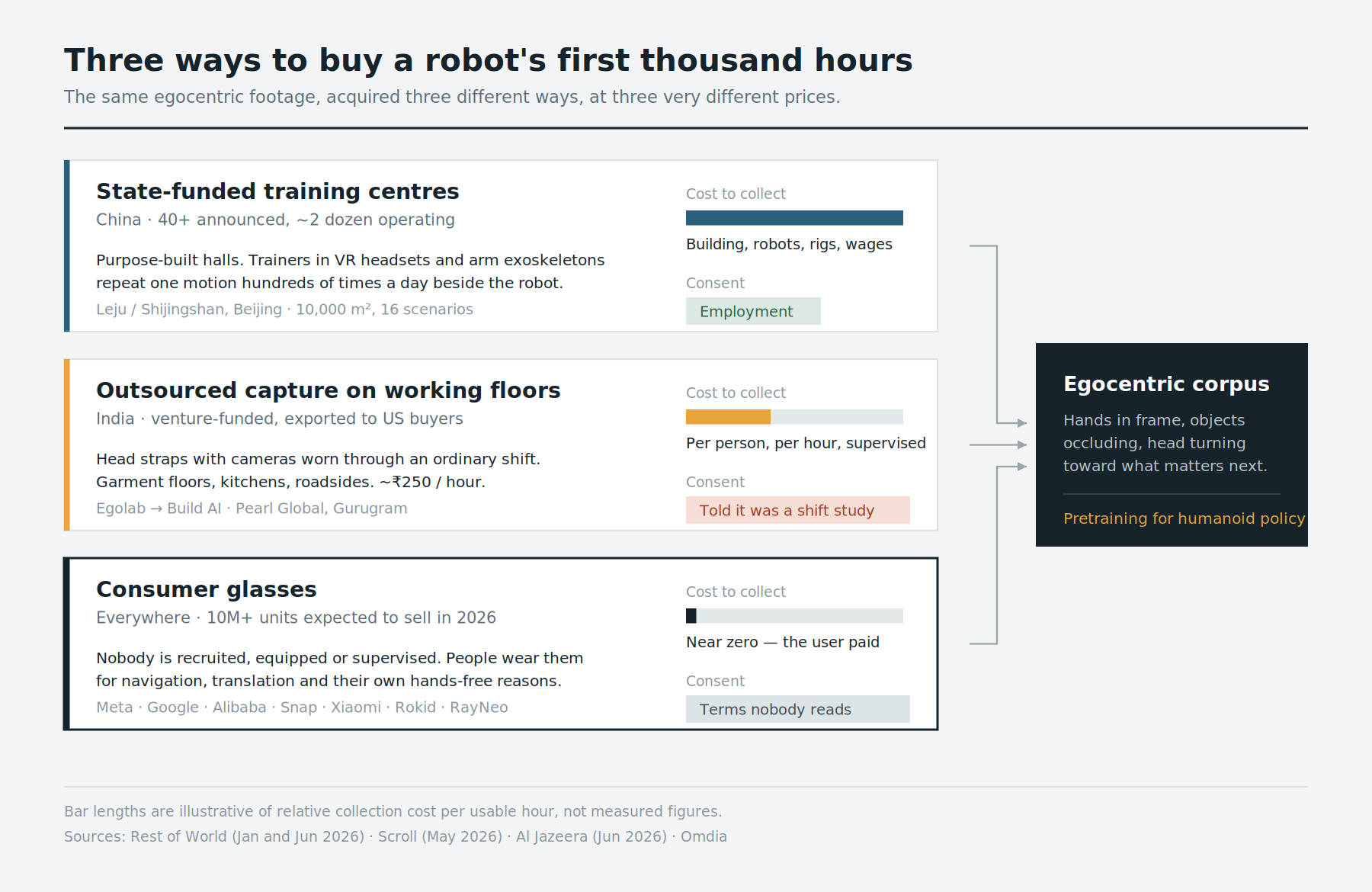
Chinese local governments have been funding state-backed robot training centres — facilities of a few thousand square metres, stocked with dozens of robots, where human trainers repeat mundane actions for hours. Interact Analysis counted more than forty announced by December, roughly two dozen already running; more recent tallies put the operating count considerably higher with more under construction. One site outside Beijing, run with the humanoid company Leju, covers over 10,000 square metres and offers sixteen scenarios — a mock car assembly line among them. A trainer profiled by Rest of World spent his week in a VR headset and arm exoskeletons, opening an imaginary microwave door hundreds of times a day so the robot beside him could learn it.4
Then there is JD.com. Working with the local government in Suqian, JD is aiming to generate ten million hours of robotics training data over two years, including a dedicated data-collection neighbourhood where residents are paid to film themselves doing household chores. The company has said it eventually wants 100,000 of its own employees and 500,000 external workers in the programme. Staff at an elderly care centre and a kiwifruit farm have been recruited to wear head-mounted cameras that record their hand movements while they work.5
That is a pair of smart glasses with the glasses taken off.
It proves demand — nobody builds a data-collection neighbourhood for a hypothesis. It does not prove the economics work. Reuters visited a centre in Liuzhou in April, and staff there acknowledged that the subsidy-dependent operation had no clear path to profitability, citing high running costs and low prices for data in an immature market.6
India is running the same play, without the state funding and with less of the consent.
In April 2026 a video went round the internet showing workers at an Indian garment factory sewing while wearing white bands around their heads with cameras mounted on them. It collected hundreds of thousands of views and a great deal of speculation about what the footage of their hands was for. Nobody reporting on it said where it was filmed or by whom — until Scroll traced it to the Gurugram unit of Pearl Global Industries, an apparel manufacturer operating in ten countries.7 A worker there told them they were instructed to wear the device from ten in the morning until four in the afternoon, and that management had explained it as a way of finding out what the workers did during their shifts and for how long.
That explanation was not the whole story. The collection was run by a startup called Egolab, which describes in its own company documents what it does: gathering labour-sourced egocentric video from factory workers with lightweight cameras, then aggregating, processing and packaging it into datasets for global AI companies building robotics and autonomous systems. Its documents name Tesla, Boston Dynamics and Figure AI as clients — its claim, not an independent confirmation. It calls itself the largest egocentric data collection effort in history, and says it will have aggregated footage from every major Indian state and sector by 2027: textiles, automotive, chemicals, electronics, steel, consumer goods. In March it was acquired by Build AI, a Delaware-registered company whose India arm sits in Bengaluru and whose founders, most of them in their late teens or early twenties, live in San Francisco.
A month after that acquisition, Build AI published Egocentric-1M: roughly a million hours of first-person footage, which its founder Eddy Xu called the internet for physical AI. It is, by a wide margin, the largest egocentric dataset anyone has released — bigger than every prior dataset combined. No per-source breakdown has been published, so I won’t assert which frames came from where. But the shape of the thing is not in dispute: a company acquires an Indian collection operation in March and ships the largest first-person dataset in history in April.8
It is not a single operator. Al Jazeera documented the wider trade in June: people recording at home, in factories, in purpose-built studios, using video glasses, head-mounted cameras and motion sensors, with an app that scolds them when their hands leave the frame. A woman slicing mangoes in her own kitchen. A 55-year-old making flower garlands by a roadside in Bengaluru, paid to work with a phone strapped to her forehead. Reported rates run around ₹250 an hour — somewhere near $2.60.9
Two things stand out.
The first is that this is the cheapest possible version of the pipeline, and it is being assembled by people in their early twenties with venture money, not by Meta.
The second is harder, and I don’t think it should be smoothed over. The women on that sewing floor were told they were part of a study of how they spent their shifts. In the company’s own documents, what they were actually producing was labour-sourced egocentric footage to be packaged and sold to firms building robots — and the tasks being recorded were precisely the manual, repetitive ones those robots are meant to take over. So the transaction, stripped of framing, is this: a person is paid roughly two and a half dollars an hour to generate the asset that makes her own job automatable, and is not told that is what she is doing.
I want to be careful about how far that goes. Being replaced by automation is not new, textile work has been mechanised in waves for two centuries, and nobody has ever asked the previous generation’s permission. What is new is the directness. The garment worker of 1850 did not personally supply the loom’s blueprints. This worker is the blueprint — her hands, her timing, her recovery from a slipped seam. Nothing else in the pipeline can substitute for her, which is exactly why the cameras went onto a working sewing floor rather than into a lab.
That is what makes the consent question more than an ethics footnote. It is the load-bearing weakness of the whole arrangement. Every hour of that footage is an asset that will be trained on for decades, and its title is clouded. When this becomes a legal question — and it will, in India and elsewhere — the cheap data will carry a cost nobody has priced in. Which is the strongest practical argument I know for doing it the other way round: a device someone chose to buy, terms they saw, a purpose they were told.
Which is the argument for the glasses, not against them. Both of these are expensive ways to get the data. In China you pay for the building, the robots, the exoskeletons, the trainers and the hours. In India you pay less, but you still pay per person per hour, you still have to recruit, equip, train and supervise them, and you inherit a consent liability that will eventually have a price attached to it. Consumer eyewear produces a lower-fidelity version of the same footage at close to zero marginal cost, collected by people who bought the device for reasons entirely their own, under terms they agreed to. Suqian and Gurugram are the proof that someone will pay for human demonstration at scale. The glasses are what happens when the cost of collecting it collapses.
That also answers a question I deliberately left aside earlier — whether ordinary people ever get paid for this. Some already are. Not through a data marketplace with a per-clip rate, but as wages: a stay-at-home mother in Jiangsu filming her chores, a garment worker in Gurugram wearing a band she was told was a productivity study, a woman in Bengaluru with a phone on her forehead earning about two and a half dollars an hour. That is the honest version of the consumer payday, and it is not a royalty stream. It is a job that exists for a few years, until footage collected passively by everyone else makes it unnecessary.
The social question mostly answers itself
There will be a fight about this, and the fight is already happening. Reporting has found that footage routed through Meta AI reached human reviewers, including moments people obviously never expected a stranger to see, and a proposed class action was filed in San Francisco in March 2026 over what buyers were told about privacy. People have disabled the recording indicator light. Universities have issued warnings. All of it is legitimate, and none of it should be waved away.
But I think the sensitivity fades, for an unsentimental reason: it always has. Every step of this has followed the same pattern. Cameras in phones were scandalous and then they were normal. Doorbell cameras were surveillance and then they were a product category. Dashcams. Body cameras. Always-listening speakers in kitchens. In each case the utility was concrete and personal, the harm was diffuse and probabilistic, and the concrete won. Norms did not hold the line — they moved to where the convenience was.
The tipping point is ubiquity. Being filmed by the one person in the room wearing glasses feels like being targeted. Being filmed when everyone is wearing glasses feels like weather. And the moment you are wearing a pair yourself, your standing to object collapses. I expect within five years the wearer will not be the conspicuous one; the person without them will be.
That does not make the privacy concerns wrong. It makes them unlikely to be decided by consumer resistance. They will be decided by regulation, litigation, and the terms nobody reads — which is a much less comfortable place for them to be decided.
The display wave, and the end of the phone
Everything above concerns glasses that only listen and look. The next wave adds a screen, and that is where the form factor stops being an accessory.
We are at the front edge of it now. Meta’s Ray-Ban Display, Alibaba’s Quark, RayNeo’s waveguide models, Snap’s Specs, Google’s display tier behind its audio tier. All of them are constrained: field of view, brightness, battery, weight, thermals. The physics is not solved. The wave after this one is where it gets solved.
When it does, the phone’s argument for existing gets thin. The phone is a rectangle you hold in your hand because there was nowhere better to put a screen. Once the screen is in your field of view and your hands are free, every interface convention we have — the app grid, the scroll, the notification shade, the thumb-sized tap target — is revealed as an accommodation to a constraint that no longer applies. Interfaces will have to be redesigned from scratch for a space that has depth, peripheral vision, and gaze.
That redesign is harder than the hardware, and it is where Meta holds an asset that gets consistently undervalued. Anyone who has spent real time in a Quest 3 — not five minutes at a trade show, but actual hours — knows that a great deal of the spatial interface problem has already been worked out. Where windows live. How you grab things. What hand tracking should feel like. How you move between contexts without menus. Meta has spent many billions and the better part of a decade on that, and most people have never seen the result. When glasses displays get good, Meta will not be starting from a blank page. Its competitors will — although they will also be free to study a decade of Meta’s answers, which is worth a great deal and costs them nothing.
And then, further out
Push the trend out far enough and it goes somewhere strange. The remaining bottleneck in all of this is bandwidth between the device and the person: input lag, the clumsiness of voice, the low channel capacity of eyes and fingers. That is the problem Neuralink and its competitors are pointed at, and it is not hard to imagine the two converging — the camera feed delivered to the visual cortex directly rather than routed through the eye, intent read without a gesture.
I am not predicting a timeline for that, and anyone who does is guessing. I mention it only because it clarifies the direction: every generation of this technology moves compute closer to perception and shortens the distance between wanting something and getting it.
What I think happens
The glasses will win on convenience. Convenience has decided every previous round of this.
Underneath that, almost incidentally, they will produce the largest first-person record of human physical activity ever assembled — millions of hours of people using tools, opening things, cooking, repairing, navigating rooms built for human bodies. That record is the raw material for the humanoid robot market, which will be one of the largest markets of the next decade.
So the strategic question is not who sells the most eyewear. It is who ends up holding the pipeline — because whoever holds it does not just own a dataset. They own the cost curve for physical labour. And that question is being settled right now, by people buying sunglasses.
Notes
- Ruijie Zheng et al., “EgoScale: Scaling Dexterous Manipulation with Diverse Egocentric Human Data,” arXiv, February 2026. https://arxiv.org/abs/2602.16710 ↩
- Ryan Punamiya et al., “EgoVerse: An Egocentric Human Dataset for Robot Learning from Around the World,” arXiv, April 2026. https://arxiv.org/abs/2604.07607 ↩
- “Tesla shifted its Optimus training strategy,” Business Insider, August 2025. Summary via eWeek. https://www.eweek.com/news/tesla-optimus-robot-training/ ↩
- “In Chinese data factories, workers teach humanoid robots boring tasks,” Rest of World, January 2026. https://restofworld.org/2026/china-robots-training-centers-workers/ ↩
- “How China is using human labor to win the humanoid robot data race,” Rest of World, June 2026. https://restofworld.org/2026/china-ai-robotics-training-data/ ↩
- Reuters reporting on the Liuzhou training centre, August 2026. https://www.insurancejournal.com/news/international/2026/08/31/883381.htm ↩
- “How Big Tech is harnessing the data of Indian factory workers to train robots,” Scroll, May 2026. The investigation that identified Pearl Global’s Gurugram unit and traced the collection to Egolab and Build AI. https://scroll.in/article/1092960/how-big-tech-is-harnessing-the-data-of-indian-factory-workers-to-train-robots ↩
- Egocentric-1M and the 2026 egocentric dataset landscape. Secondary summary; I could not locate a primary release announcement. https://www.labellerr.com/blog/egocentric-datasets-robotics/ ↩
- “India’s workers are training AI robots to take their jobs,” Al Jazeera, June 2026. https://www.aljazeera.com/gallery/2026/6/11/photos-indias-workers-are-training-ai-robots-to-take-their-jobs ↩
Further reading: Ruihan Yang et al., “EgoVLA: Learning Vision-Language-Action Models from Egocentric Human Videos,” arXiv:2507.12440 — the methodological predecessor to EgoScale.

Leave a Reply