A couple of hours ago Brett Adcock, the CEO of Figure, did something founders almost never do in public. He wrote a post-mortem on his own worst engineering decision. Not a competitor’s. His own.
The short version
- What happened. Adcock called the tendon-based hand he chose for Figure in 2022 maybe the worst engineering decision of his last four years, and described tendons as “a complete local maximum.”
- Why it lands hard. Tesla has spent two years rebuilding the Optimus forearm around that exact architecture, and 1X unveiled a 25-degree-of-freedom tendon hand five weeks ago. Same physics, opposite conclusions.
- What a tendon hand is. Motors in the forearm, thin high-strength cables pulling the fingers, copied straight from your own anatomy. You get slim fingers and a lot of joints. You pay in friction, stretch, wear at the anchor points, and fingers that twitch when the wrist moves.
- What Tesla is doing about it. Cables routed through channels machined into the finger bones, a wrist that re-stacks the whole bundle to cancel crosstalk, and rolling joint surfaces in place of pins. Musk has already said one published version of that joint did not work.
- Who else is in the fight. 1X and Shadow on tendons, Sanctuary on hydraulics, Clone on artificial muscle, and a Chinese cluster winning on volume and price rather than spec sheets.
- Where I think it lands. Hybrid hands rather than pure architectures, loaded cycle life replacing degrees of freedom as the number that matters, and hands that get serviced like tyres.
The biggest engineering mistake I made at Figure was building a tendon-based hand
— Brett Adcock (@adcock_brett) August 13, 2026
The line that matters sits in the middle of it: “Tendons are a complete local maximum, and that only becomes clear in hindsight, after exploring every other possible hand design.” Figure built the hand for its F.01 robot in 2022, manufactured it, tested it in early 2023, and Adcock says it was an engineering work of art. He also says it was the wrong answer, and that Figure’s next hand is “so much better than anything you can do with tendons, it’s not even funny.”
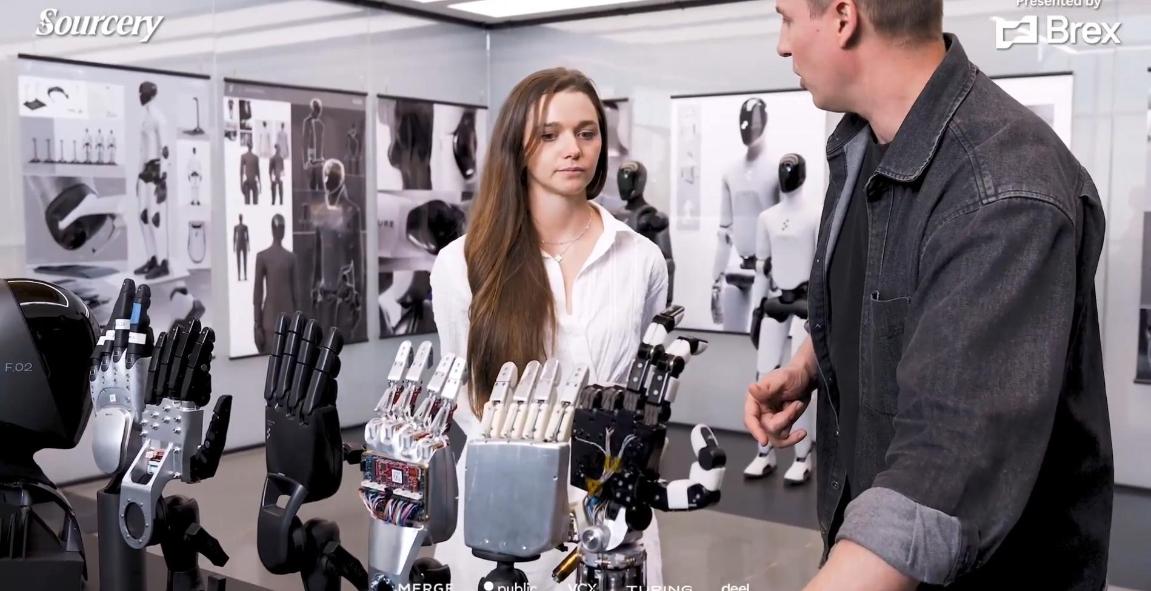
He went into it at more length in an interview with Sourcery a couple of days ago. This is the clip his post was quoting, and where the photo at the top of this article comes from.
.@adcock_brett explains why @Figure_robot pivoted away from designing their humanoid robot's hands after human hands
— sourcery (@sourceryy) August 11, 2026
One line from that video is the reason this article exists at all: “If we want to solve AGI and get to human intelligence in the physical world, it’s all going to start with the hands.”
Why a human-shaped hand, and not something smarter
The hand is the humanoid. Everything else is a way of getting a hand to the right place.
Ask why a robot should be shaped like a person and the honest answer has nothing to do with legs. It is that the physical world has already been built to fit one specific tool: the human hand. Door handles, drill triggers, dishwasher racks, ring pulls, zips, light switches, jar lids, suitcase straps, every tool in every workshop — all of it was designed by people with hands, for people with hands. Copy that one organ and you inherit all of it for free. Fail to, and somebody has to re-engineer the world around your machine, at which point you should have bought a robot arm and a jig.
So this article is only about hands that are trying to be hands. Five fingers, an opposable thumb, roughly human proportions, many joints you can move independently. The two- and three-finger grippers on factory arms are fine machines and a completely different subject. They work because the object, its pose and the workcell are all known in advance. Remove those three assumptions and they stop working, and removing those three assumptions is the whole premise of the humanoid.
The bar is brutal. A human hand has 27 degrees of freedom, more than thirty muscles driving it, and roughly 17,000 touch receptors in the skin. It does the power grip on a sledgehammer and the precision grip on a sewing needle with the same hardware, and it repairs itself. Nobody is close. Hands are also 14 to 20 per cent of a humanoid’s bill of materials and, by Tesla’s own account, about 60 per cent of the engineering. This is not a rounding error on the robot. It is a fifth of the parts cost and most of the difficulty.
Elon Musk has been blunter about that difficulty than anyone else with something to sell. On Tesla’s Q3 2025 earnings call:
Making the hand and forearm, because most of the actuators, just like the human hand, the muscles that control your hand are actually primarily in your forearm. The Optimus hand and forearm is an incredibly difficult engineering challenge. I’d say it’s more difficult than the rest of the robot from an electromechanical standpoint. The forearm and hand are more difficult than the entire rest of the robot. But really, in order to have a useful generalized robot, you do need an incredible hand.
Elon Musk, Tesla Q3 2025 earnings call
He has also rated human-level manual dexterity as “harder than Cybertruck or Model X, somewhere between Model X and Starship.”
What a tendon-based hand actually is
Put your left hand flat on your right forearm and wiggle your right-hand fingers. The muscles doing the work are under your left palm, not in your fingers. Fingers are almost pure structure: bone, ligament and tendon, with thin strong cords running from the muscle bellies in the forearm, through a tunnel at the wrist, out to each fingertip. Muscle pulls, tendon transmits, finger curls.
A tendon-driven robot hand copies that arrangement. Motors live in the forearm and thin cables run through routing channels into the fingers, almost always UHMWPE fibre sold as Dyneema or Spectra, which is lighter than water and roughly fifteen times stronger than steel for its weight. Spool it in, the finger closes. The two alternatives are direct drive, one small motor at each joint with no cables at all, and rigid linkage, a few motors in the palm with mechanical bars making several joints move together in a fixed ratio.
Tendons are seductive for good reasons. The finger can be human-sized, because nothing has to fit inside it. The forearm is a much bigger box than the hand, so you can afford more motors, which buys more independently controlled joints. A light hand accelerates faster, hits softer and is cheaper to crash, and the heat ends up somewhere that can shed it. Adcock listed almost exactly this reasoning in his post as why he chose it. He is not saying it was stupid. He is saying it was a trap.
Here is the trap:
- Cables only pull. Nature pairs every flexor with an extensor, so a robot needs two cables per axis or a cable plus a return spring. Double the parts, or give up control authority.
- Friction, stretch and creep. Every bend in the cable path adds friction. The motor knows how far it turned but not where the fingertip ended up, and that error grows as the hardware ages. UHMWPE also creeps under sustained load and softens well below 90 °C, so tendon hands need re-tensioning. Tolerable in a lab, miserable across a fleet of ten thousand robots.
- The anchor fails before the fibre does. Teardowns suggest a 150 N-rated tendon holds about 100 N after limited cycling, because the knot or sleeve degrades long before the cable. Cycle life collapses under load too: one read of 1X’s own literature puts NEO’s tendons at roughly 2 million cycles nominal and about 100,000 at three times load.
- Crosstalk. The nasty one. Cables running from forearm to fingertip pass through the wrist, so bending the wrist changes their path length and pulls the fingers. The robot twitches its grip every time it rotates its wrist, and drops the glass.
The alternatives are not free either. Direct drive gives clean per-joint control and an easy jump from simulation to reality, and charges for it in miniature gearboxes, the most expensive item in any hand, plus a thermal problem: holding a grip means a tiny motor pulling current with nowhere to dump the heat. Linkage hands are cheap and tough and cannot reorient an object in the palm, because joints that are mechanically coupled cannot be moved independently. There is no free lunch, only a choice about where you want the failure to live.
Tesla: the same idea, rebuilt three times
Tesla has been on the tendon path since the beginning. What has changed, twice, is where the motors sit and what the joints are made of.
AI Day, September 2022. The first real Optimus hand: five fingers, 11 degrees of freedom, six actuators, metallic tendons through the fingers. Deliberately underactuated, with one cable per finger pulled by a motor inside the hand, curling the joints in sequence so the finger wraps around whatever it meets. Tesla called it adaptive grasp and it is a lovely piece of engineering: one motor, and the finger conforms to a drill or an egg without being told which it is holding. The price is that you cannot drive the joints independently, so you cannot turn an object over in the palm.
Optimus Gen 2, December 2023. Same 11 degrees of freedom, faster, now with tactile sensing on every finger. This is the version in the egg-handling clip. Still six actuators, still inside the hand.
2024, the admission. Talking to Lex Fridman, Musk said the hand was “probably roughly half of the engineering” of Optimus electromechanically, then explained why the first approach had to go. “The current Optimus, we tried to put the actuators in the hand itself. Then you end up having these…” Fridman finished it for him: “giant hands.” Musk: “Yeah, giant hands that look weird.”
2025, the struggle in public. When Marc Benioff posted video of a Gen 2.5 prototype in September, the robot appeared to be wearing non-functional mannequin hands. A month later came the earnings call quote above.
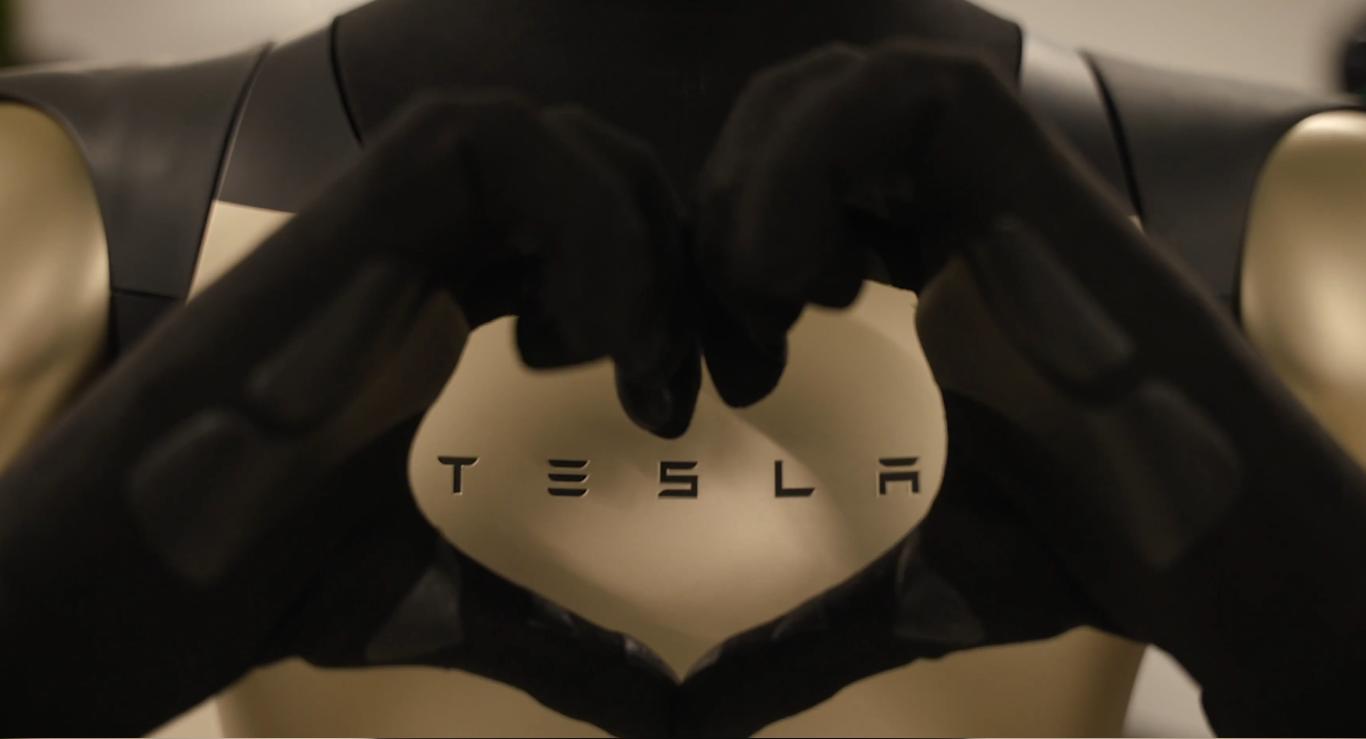
April 2026, the patents land. Two filings, “Mechanically Actuated Robotic Hand” and “Robotic Appendage,” both filed on the same day as the October 2024 We, Robot event, were published internationally. They describe a hand that inverts almost every choice made in 2022.
What Tesla is doing differently
- Everything moves to the forearm. 22 degrees of freedom, four per finger plus two at the wrist, with three cables per finger running down from motors that are no longer in the hand at all. Chinese sell-side teardown analysis reads the shipping version as 17 active plus 5 passive degrees of freedom driven by 17 motors, using a planetary gearbox and a planetary roller screw to turn motor rotation into tendon pull, with 22 Hall sensors and 94 tactile contact points. Against six actuators per hand in Gen 2, that is a different machine.
- Machined channels instead of pulleys. The cables do not run over free pulleys inside the finger. They pass through precision channels cut into the finger bones, deliberately routed behind some joints and in front of others so that pulling one cable produces exactly one motion, and so that no two cables can cross and saw through each other. The fibre itself is a commodity you can buy by the spool; all the engineering value is in how you route it and how you tie it off.
- The orthogonal wrist router. The best idea in the filing, and a direct answer to crosstalk. On the forearm side the cables leave in a flat horizontal stack, which sits close to the axis of the wrist’s up-and-down pitch, so pitching barely changes their length. Passing through the wrist joint the bundle is re-ordered into a vertical stack, which puts it close to the axis of side-to-side yaw. The wrist can then move in both axes without tugging the fingers.
- Rolling contact instead of pins. A pin through a hole wears, develops play and generates friction. Instead the finger segments have curved mating surfaces that roll against each other, held together under tension by a composite flexible member. On paper: less wear, less friction, fewer parts, easier to build at volume.
Now the part that keeps this honest. Three days after the patents were published, someone asked Musk about that rolling-contact joint. His reply, on 19 April 2026: “We already changed the design. This one didn’t actually work.”
So the story is not that Tesla solved tendons. It is that Tesla is still committed to them, is grinding through their failure modes one at a time (routing, termination, crosstalk, joint wear), and has already binned at least one published attempt at the joint. The V3 unveil, once expected in the first quarter of 2026, has been pushed closer to production so competitors have less time to copy the work.
How others are solving the hand problem
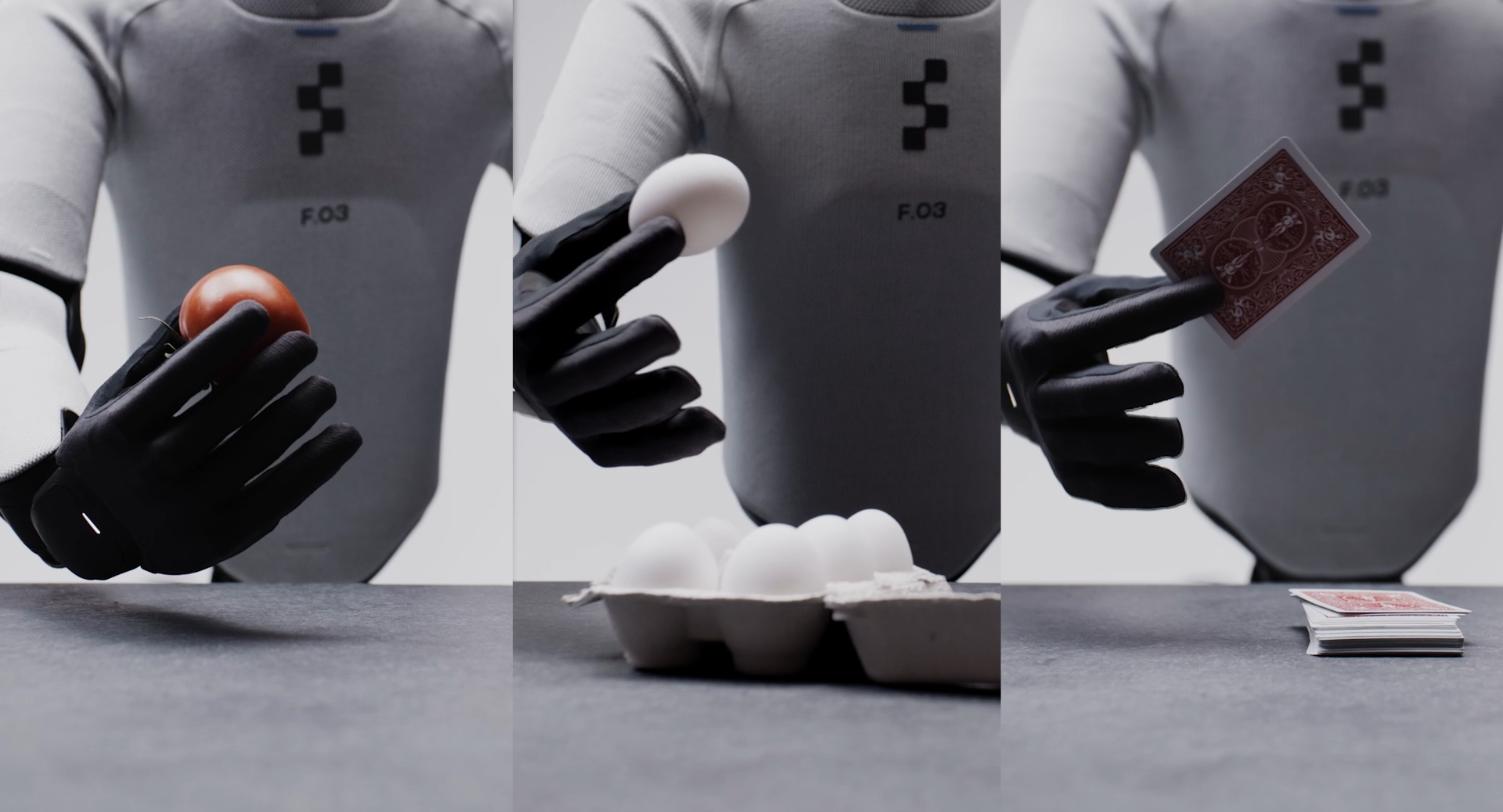
Figure (US). The F.01 tendon hand of 2022 and 2023, then the fourth-generation hand on Figure 02 in August 2024 with 16 degrees of freedom and human-equivalent grip strength, then Figure 03 in October 2025 with tactile fingertips developed in-house that resolve forces down to three grams, the weight of a paperclip, plus a camera in each palm for when the head cameras cannot see inside the cabinet. Figure has now built and tested several complete architectures, which almost nobody else has done, and that is the basis of Adcock’s claim to know where the peak is. Though: Figure has published neither the joint count nor the drive architecture of the replacement. All we have is his word that it has as many joints as a human hand.
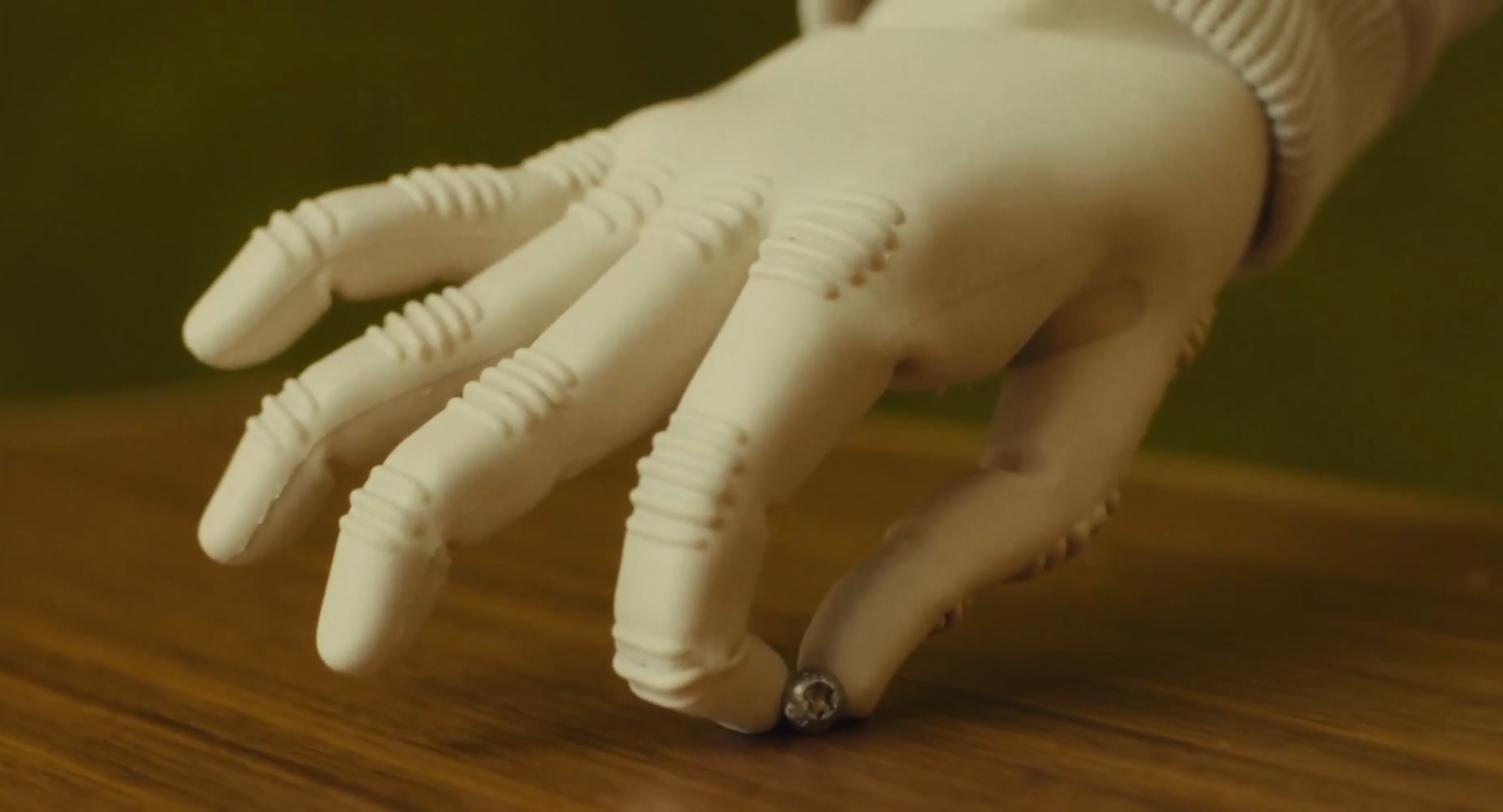
1X (Norway and US). The most direct rebuttal on the table. In July 2026, 1X unveiled NEO’s new hands: 25 actuated degrees of freedom, 22 in the fingers and palm plus three at the wrist, every one of them pulled by a tendon from a motor in the forearm. Force-controlled and backdrivable throughout, 45 N of fingertip pinch, tactile skin on every contact surface, ±0.2 mm positioning, and IP68 sealing so the robot can work in water and wash its own hands. The whole stack is built in-house, in a California factory sized for 10,000 units a year. That is not a demo. That is a factory bet on tendons, placed five weeks before Adcock’s post.
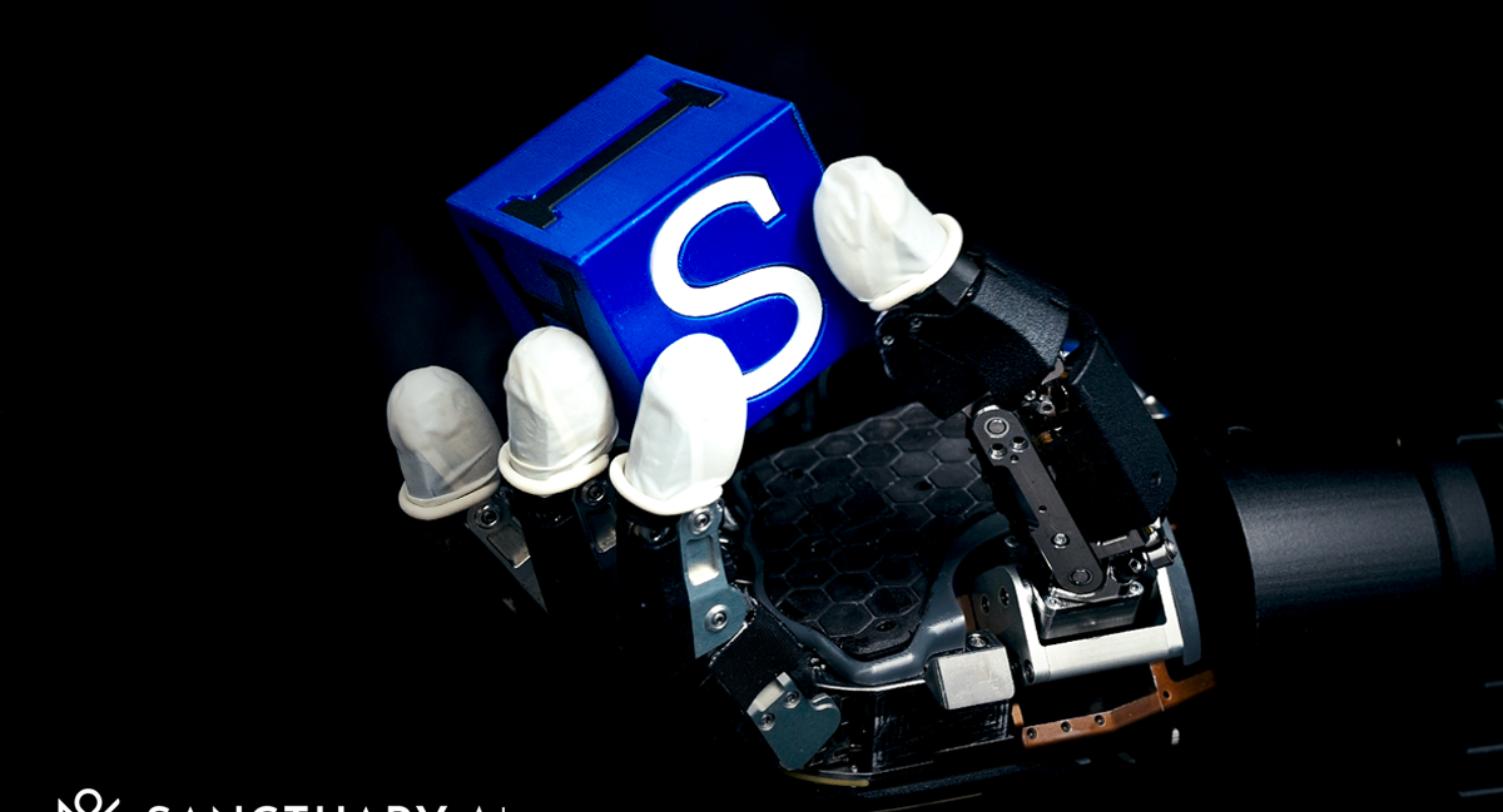
Sanctuary AI (Canada). A third road entirely. Miniature hydraulic valves instead of electric motors, 21 degrees of freedom per hand, and a seven-cell micro-barometer array added to each fingerpad in early 2025. Hydraulics carry roughly an order of magnitude more power per unit volume than cable-and-motor systems, and Sanctuary reports valve actuators running past two billion test cycles without leaking. They have also shown zero-shot transfer, a policy trained entirely in simulation reorienting real objects with no fine-tuning, which is the hardest trick to pull off with a compliant hand.
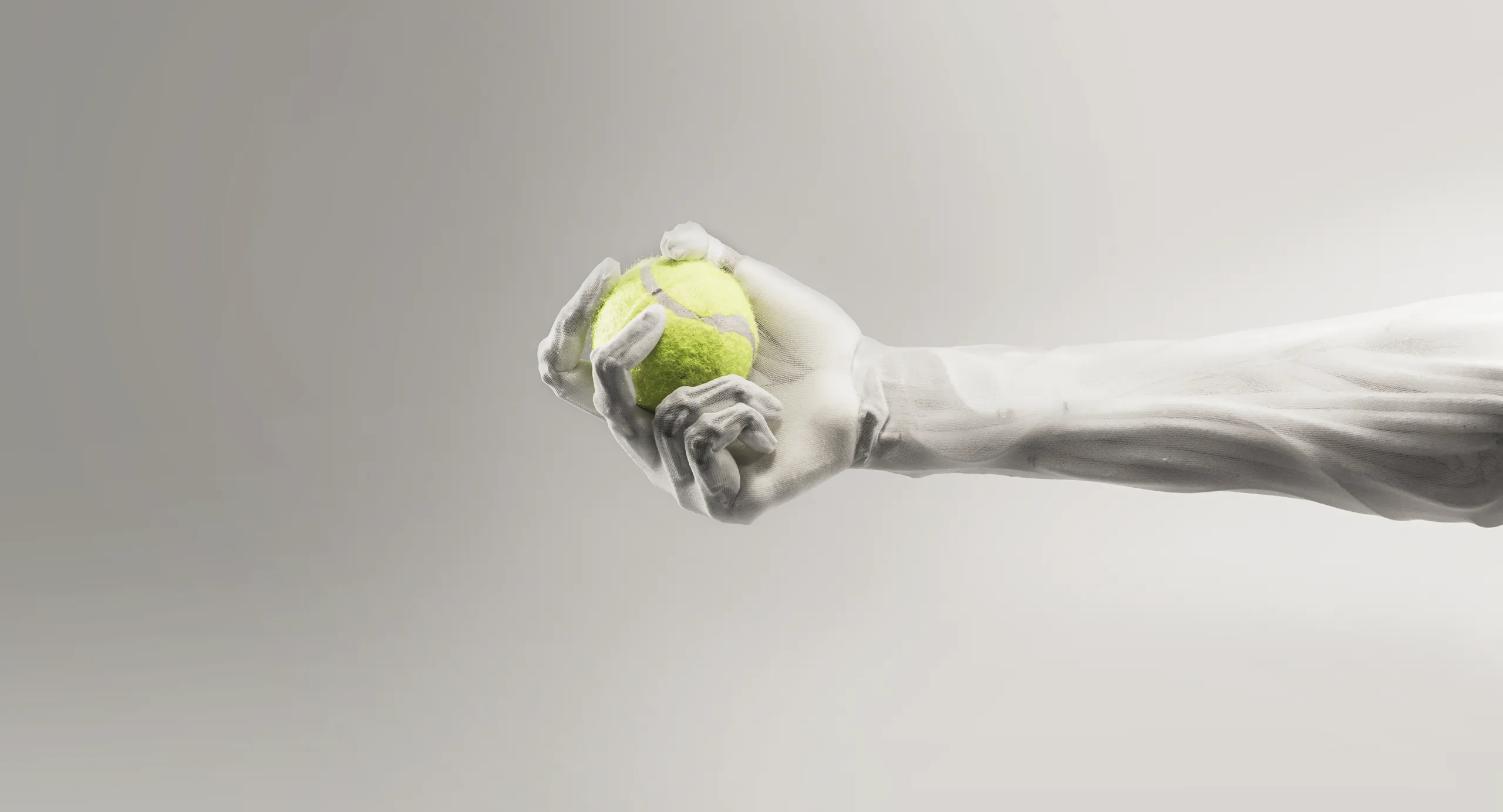
Clone Robotics (Poland). The most literal biomimicry in the field. Their Myofiber actuators are hydraulic artificial muscles, mesh tubes that contract when pressurised, and they build skeletons rather than chassis. The Clone Hand runs 37 of them, lifts 7 kg and is rated to around 650,000 extension cycles. If you think the answer is to copy biology properly, this is what that looks like.
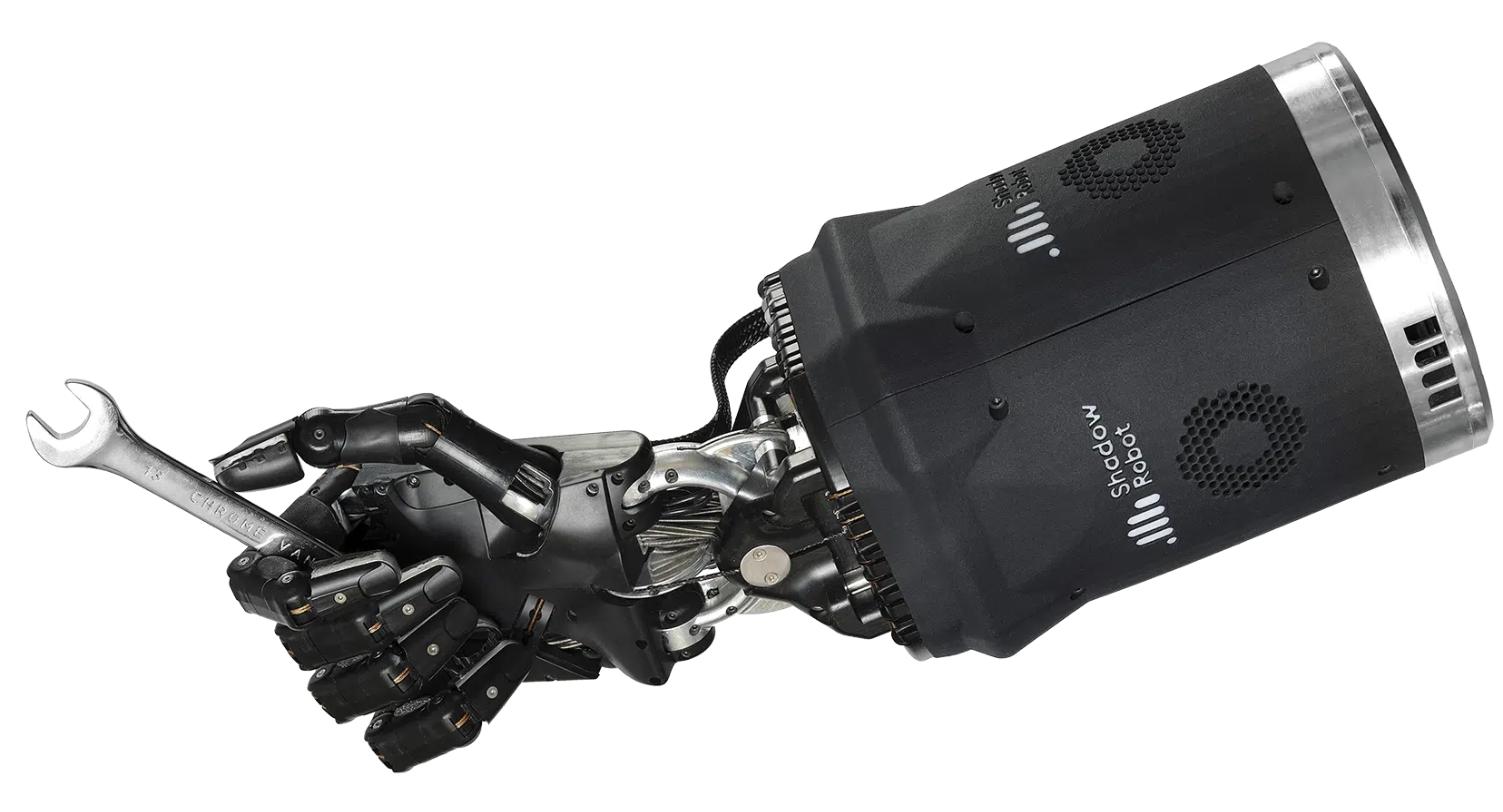
Shadow Robot (UK). The grandparent of the field and the proof that tendon hands can work: 24 joints, 20 actuated degrees of freedom, 40 Spectra tendons pulled by 20 motors in antagonistic pairs, 129 sensors. It has been the standard research platform for two decades. It also costs six figures per hand and weighs nearly 5 kg with the forearm. Shadow proves the physics, and shows what the physics costs when nobody is allowed to compromise.
China, where the volume is
Everything above is the Western story, and it is the smaller half. China has more companies building serious anthropomorphic hands than the rest of the world combined, and on the metric that eventually decides these things, units out the door, it is not close. The multi-finger hand market was worth about $123 million in 2024 and is forecast at $5.8 billion by 2031. Five years ago a tactile sensor was an import costing more than ¥100,000; domestic versions now go for a couple of hundred yuan. High-end research hands still sell for $150,000 in the West. Chinese hands with comparable joint counts sell for low four figures. Three worth knowing:
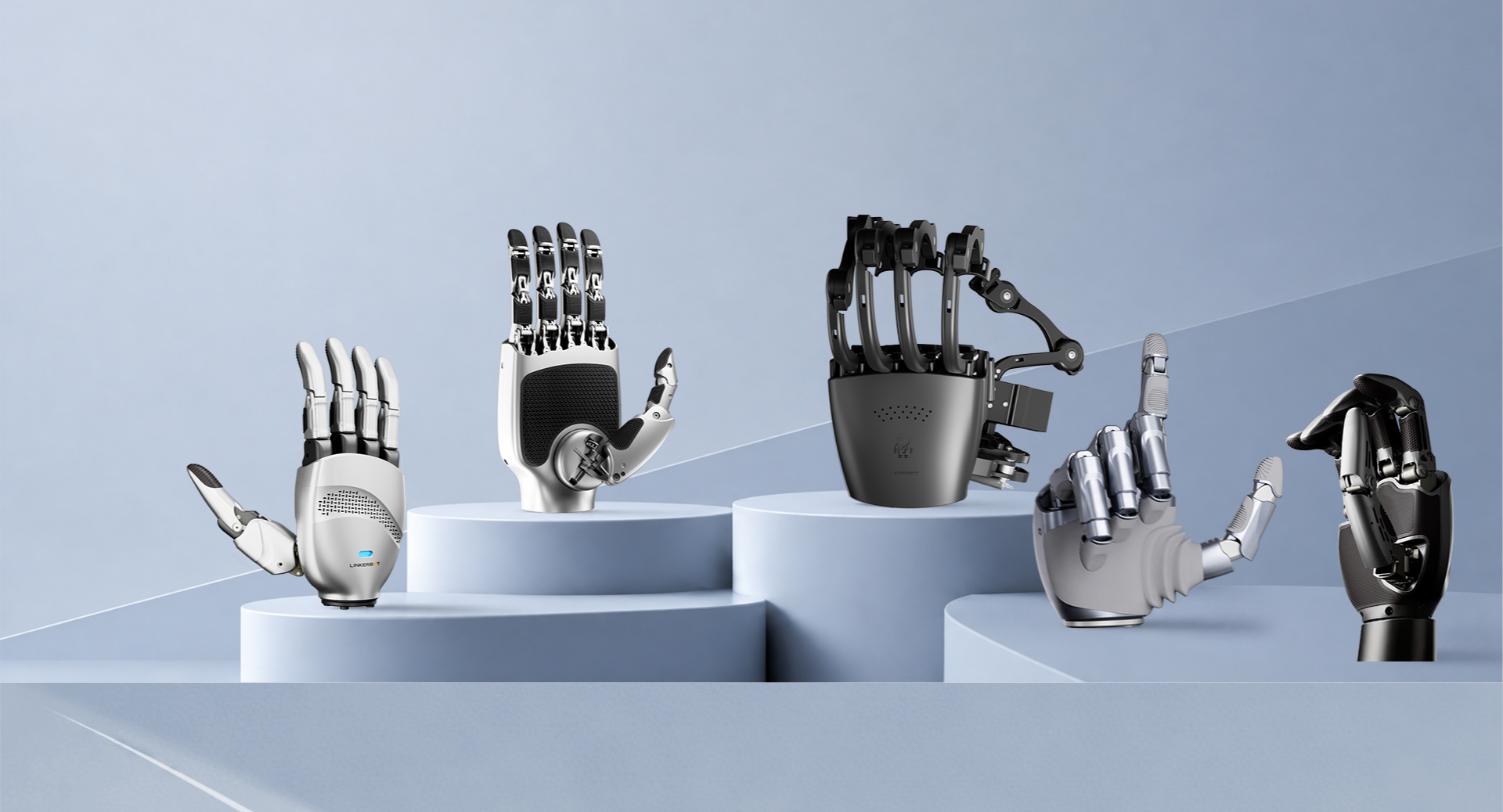
LinkerBot (灵心巧手). Founded in 2023 and already the category leader, with a claimed 80 per cent of the global market in high-degree-of-freedom hands and the only production line putting out more than a thousand of them a month. It raised roughly ¥1.5 billion in a Series B in February 2026 and is targeting 50,000 to 100,000 units this year. What makes it interesting is not the share number, which is company-supplied, but the hedge: LinkerBot ships tendon, linkage and direct-drive hands side by side. While Figure and Tesla bet the company on one architecture, LinkerBot sells all three and lets customers settle the argument. Its founder expects prices under ¥500 within three years, which if it happens ends the discussion about whether hands are a moat.
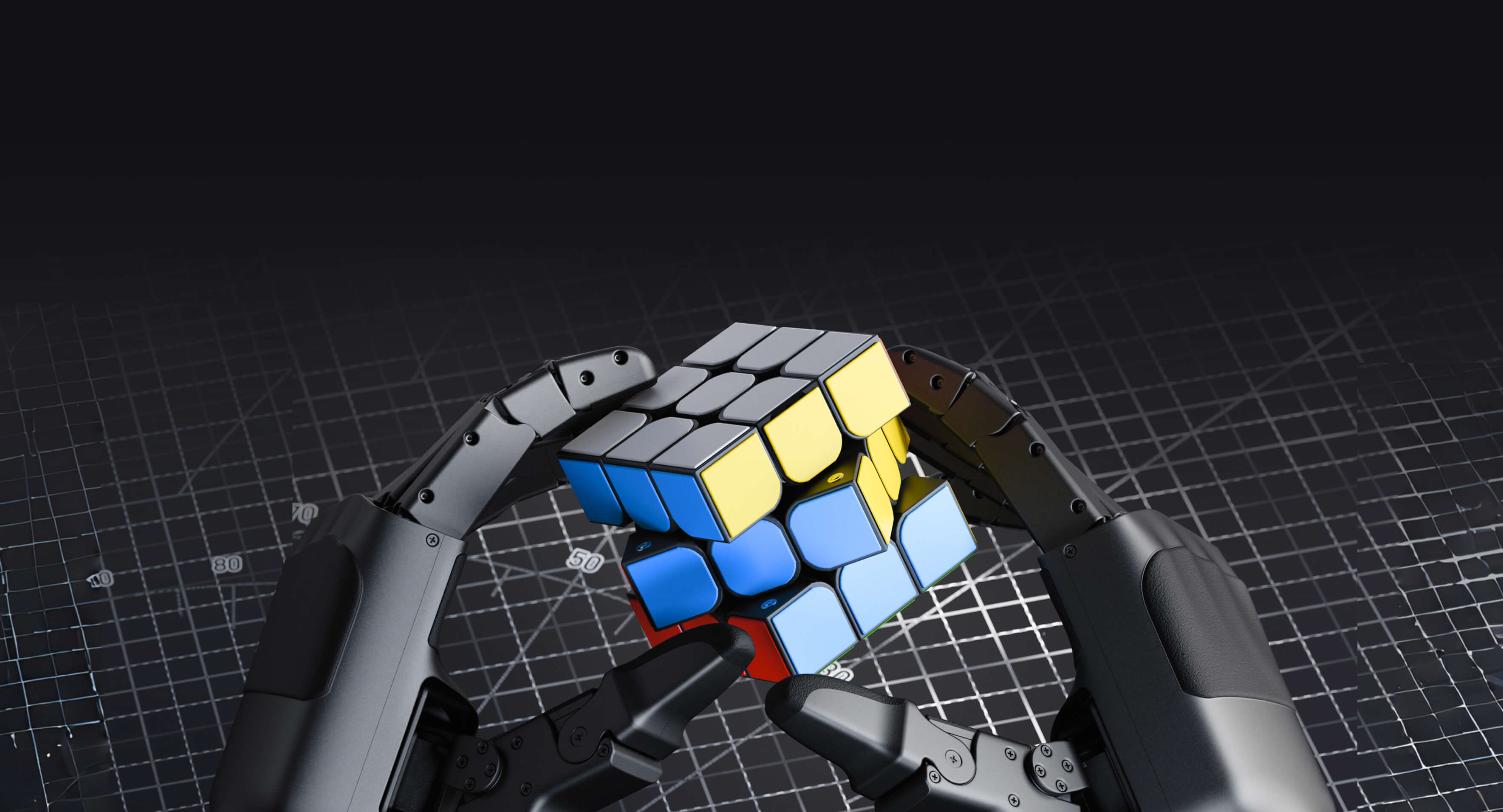
Unitree (宇树科技). The Dex5-1 has 20 degrees of freedom, 16 of them active, backdrivability on every joint for direct force control, ±22° of finger splay and ±1 mm fingertip repeatability, in a 1 kg package rated to 4.5 kg. The sensing version adds 94 force sensors across palm, fingertips, finger bodies and knuckles. Unitree’s March 2026 IPO prospectus disclosed the full ladder: Dex5-1 at the top, a three-finger Dex3-1 in the middle, a plain gripper at the bottom, all on self-developed motors. The ladder is the point. Nearly three quarters of the humanoids Unitree shipped in 2025 went out with no hands at all, because customers would not pay for them. Unitree is one of the few companies that can watch demand climb that ladder inside its own order book.
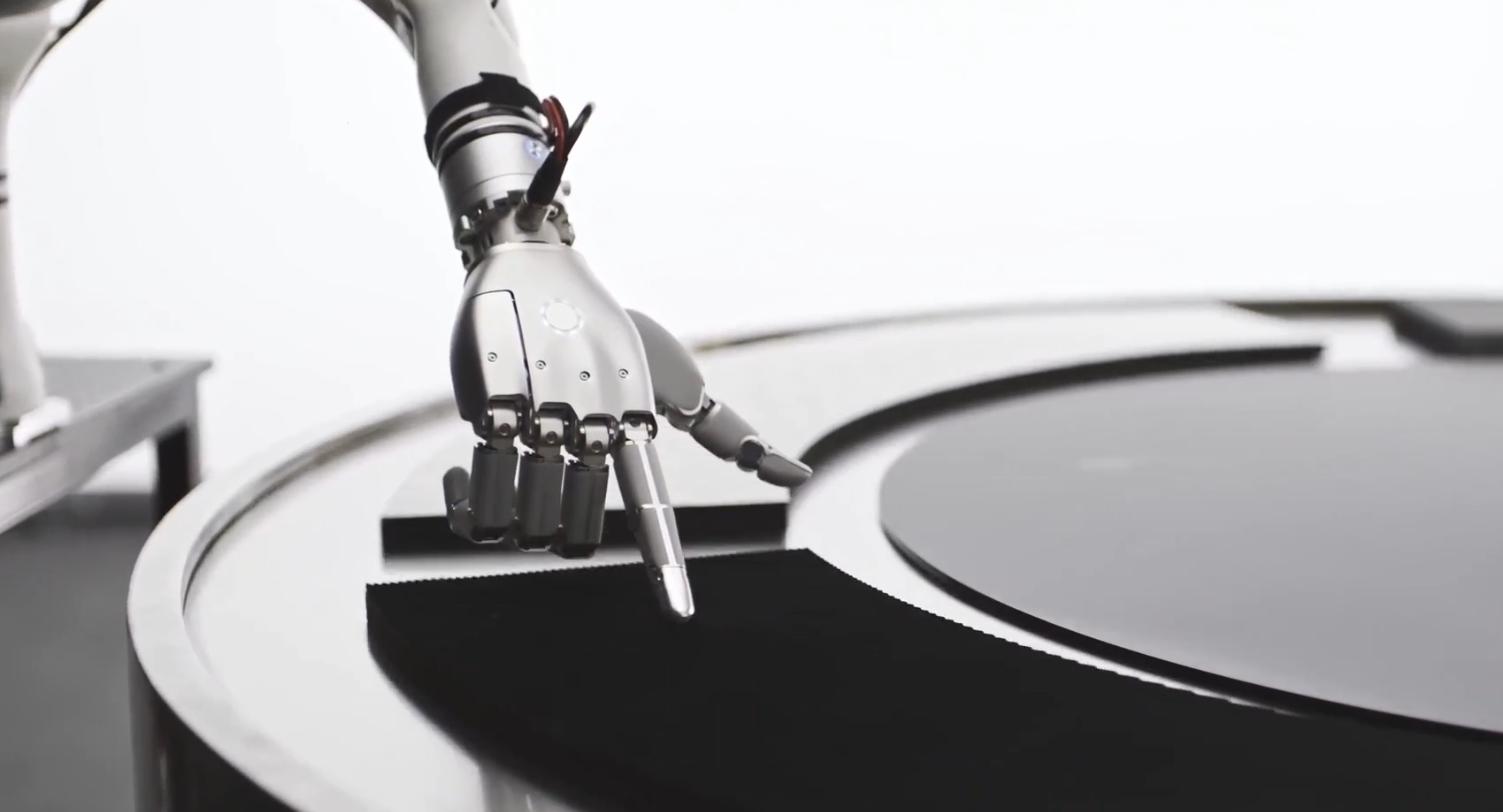
Sharpa. Headquartered in Singapore with engineering split between Shanghai and Mountain View, and founded by people who came out of Hesai, so read it as part of the Chinese ecosystem rather than a domestic champion. SharpaWave has 22 actively driven degrees of freedom and the densest touch sensing anyone has put on a commercial hand: over a thousand tactile pixels per fingertip, sub-millimetre spatial resolution, 0.005 N sensitivity across a 0 to 30 N range, and a miniature camera in each fingertip on top of that. The palm-width-to-length ratio is deliberately set at 0.618 so the hand fits human tools. It went into mass production this year and has been folded into NVIDIA’s and Unitree’s humanoid reference designs, which is the fastest route to becoming the hand a lot of robots ship with by default.
Behind those three sit PaXini, whose DexH13 packs nearly a thousand tactile points and a palm camera into four fingers, Zhaowei and Leisai coming up from the motor business, Inspire delivering in the tens of thousands, and Agibot spinning its hand division into a separate company in January. The Western programmes are still setting the ceiling on what a hand can do. China is setting the floor on what one costs, and the floor is falling much faster than the ceiling is rising.
Where I think this ends
Four predictions, in increasing order of confidence.
The hybrid wins, not the pure architecture. The physics points at a split: tendons for finger flexion, where you want slim fingers and real force and the motion is a simple curl, and direct drive for finger spread and the wrist, where independence and precision matter and there is room for a motor. My guess is that Tesla’s and Figure’s next hands both land on some version of this inside two product generations, and the argument quietly stops being interesting. LinkerBot has already skipped the argument by selling all three.
The spec that decides this is not degrees of freedom. DoF counts are marketing. The number that separates winners from losers is loaded cycle life: how many grasps the hand survives at realistic force, not unloaded on a bench. Whoever publishes a credible, reproducible test protocol for that ends up writing the rules everyone else is judged by, the way semiconductor datasheets converged on a common language.
Hands become serviceable consumables. Quick-swap fingertips, quick-swap fingers, a documented service interval measured in months. Human hands heal; robot hands will be designed to be replaced. That is not a failure, it is what happens to every part that takes the impacts.
The hand is a moat, briefly, and then maybe not. Manipulation data is recorded in the kinematics of the hand that collected it, so today choosing a hand is closer to choosing a platform than buying a component. If the hardware-agnostic foundation-model crowd succeeds, that advantage evaporates and hands become interchangeable peripherals sold on price, which is the outcome the Chinese cost curve is already pricing in. If it fails, whoever fields the most working hands compounds fastest. Nobody honest claims to know which way that goes.
Adcock is probably right that his 2022 tendon hand was a local maximum. That is a different claim from tendons being a local maximum, and the timing is unkind to the stronger version: he published it five weeks after 1X put 25 tendon-driven degrees of freedom into a product it is already taking orders for, and while Tesla spends what it says is 60 per cent of its total robot engineering effort making the same idea manufacturable.
The thing about a local maximum is that you can only see it once you have climbed it. Several companies are currently on several different hills and none of them has reached the top. What I do not doubt for a second is Adcock’s other claim, that this all starts with the hands. Everything else about a humanoid robot is a way of getting a hand to the right place.

Leave a Reply