Imagine standing in the main hall of Beijing’s World Robot Conference, surrounded by the usual parade of slick humanoid prototypes — nimble torsos, polished white casings, maybe 1.7 meters tall on a good day. Then you round a corner and see it: four meters of steel and hydraulics staring back at you, weighing more than a car. That’s the NeodraDynamics Super Humanoid Robot (超人形机器人), unveiled this week at WRC 2026 — and it is something else entirely.
Not Your Average Humanoid
The numbers alone reframe what a humanoid robot is allowed to be. Standing 4 meters tall and tipping the scales at over 1,000 kg, the Super Humanoid isn’t just big — it’s categorically different from everything else in the field. Tesla’s Optimus is 1.73 meters and about 57 kg. Boston Dynamics’ Atlas weighs under 90 kg. NeodraDynamics has built something that makes those machines look like action figures.
To put it in everyday terms: this robot is roughly as tall as a double-decker bus is wide, and heavier than most passenger cars. It can carry up to 500 kg across both arms combined. Each finger is capable of exerting up to 200 kgf of grip force — yet the same hand achieves fingertip repeat positioning accuracy of ±0.005 mm. That’s sub-10-micron precision from a hand that could crush steel. Force and finesse, at machine scale.
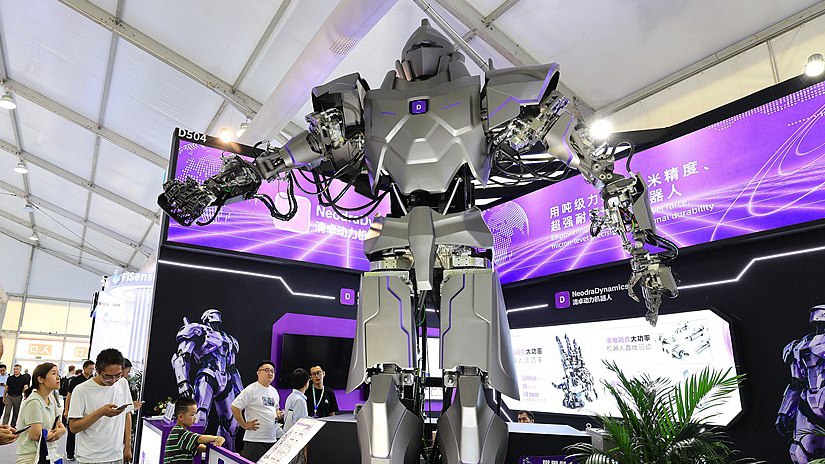
The secret is what NeodraDynamics calls its hybrid hydraulic-electric integrated drive — a fusion of digital hydraulic cylinders and electric motors that the company says breaks the fundamental power ceiling of pure-electric systems. The core component is a micro digital hydraulic cylinder weighing just 1.6 kg, capable of 10 kilonewtons of push force at 50 mm per second. String those across a 4-meter bipedal frame with 7 degrees of freedom per arm and 15 per hand, and you have a platform the company says can scale “from kilogram-level to thousand-tonne-class loads.” It’s not a single product — it’s an architecture.
The environmental specs are equally striking. The Super Humanoid is rated for −40°C to +80°C standard operation (with a −40°C to +300°C extreme variant), nuclear radiation resistance, deep-sea operation at 10,000 meters depth, strong magnetic fields, and corrosive chemical environments. This is a robot explicitly designed to go where humans shouldn’t.
The Team Behind It
NeodraDynamics (清卓动力机器人科技(北京)有限公司) is a Beijing startup barely a year old, but its co-founders bring serious institutional credentials. Jianwei Zhang holds simultaneous foreign membership in both the Chinese Academy of Engineering and acatech, the German National Academy of Science and Engineering — an extraordinarily rare dual distinction. Jian Wang, a motor and servo drive expert, sits on China’s MIIT Robot Standards Committee. CEO Tao Yang is the inventor of the company’s core digital hydraulics technology, with a background in automatic control systems.
Importantly, NeodraDynamics positions itself as much as a component supplier as a robot builder. Its High-Power Dexterous Hand and Micro Digital Hydraulic Cylinder are available as standalone products for other platforms. The Super Humanoid is, in a sense, the ultimate demonstration unit for what those components can do when you stop worrying about fitting through a doorway.
Built for the Worst Places on Earth (and Off It)
NeodraDynamics frames its targets around “4D scenarios” — Dangerous, Dirty, Dull, and Difficult. The intended deployment zones read like a list of the hardest jobs in industrial civilization: nuclear plant inspection and maintenance without human radiation exposure; deep-sea sample collection and equipment maintenance at crushing pressures; heavy automotive and machinery assembly requiring both massive force and high precision; container and bulk cargo handling in ports; emergency disaster response — debris removal, heavy object extraction. The company also explicitly names hazardous chemical handling, space exploration, and construction in extreme conditions.
Each of those domains has something in common: they’re environments where human-scale robots offer no particular advantage, where scale and environmental hardening matter more than the ability to use a coffee maker.
What This Changes
The humanoid robot conversation has been dominated, almost entirely, by the race to human scale: make the robot human-sized, human-shaped, and human-capable. The logic is sound — human environments are built for humans, so human-form robots can navigate them. But NeodraDynamics is betting on a different premise: the environments that generate the most value from robotic automation aren’t designed for humans at all. They’re nuclear reactors, deep-sea rigs, heavy fabrication floors, and disaster zones — places where the constraint isn’t fitting through a doorway, it’s surviving the environment and doing work that demands massive, precise force.
At 4 meters and a ton, the Super Humanoid is a deliberate provocation against the field’s assumptions. Whether NeodraDynamics can translate a striking WRC prototype into deployed, production-ready systems is the question that will determine whether this is a genuine category shift or a very impressive engineering statement. But as a vision of what humanoid robotics could look like when you stop treating human scale as a sacred constraint — it’s impossible to ignore.
Sources
Snob.ru — В Китае разработали четырёхметрового робота-тяжеловеса
NeodraDynamics official site
CGTN — Robots move closer to real-world partners at World Robot Conference

Leave a Reply